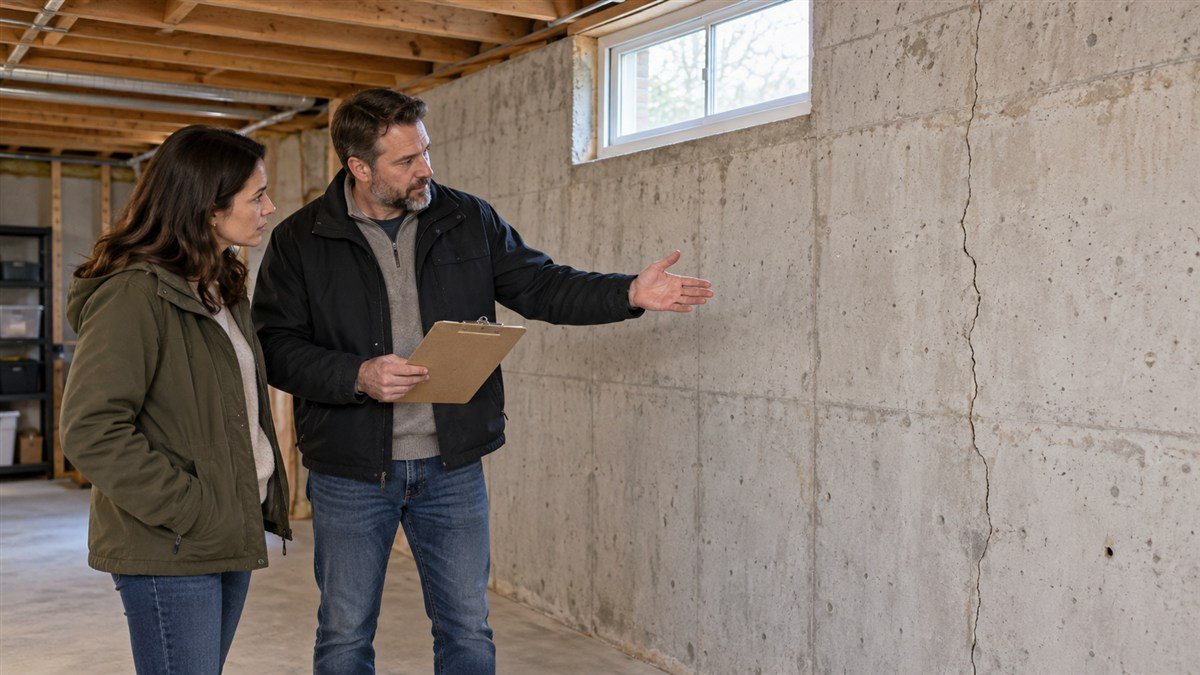
AI-generated editorial illustration; not an Aftermath inspection, customer or project.
Buying a house with foundation cracks calls for more than a seller’s assurance that a repair was done. Ask what was found, which part was repaired and what evidence connects that work to the wall you can see today. A crack, a dry viewing or an old invoice cannot settle the purchase decision on its own.
For Toronto and GTA buyers, the useful starting point is a clear handover of information. This guide explains which records to request, how to separate past work from present questions and where warranty assumptions can go wrong. It does not assign a buy-or-walk-away verdict to a crack photograph.
Buying a house with foundation cracks: what should you ask first?
Start by asking what the current inspection can establish and what remains unknown. Then compare those findings with any earlier reports or repair history. Keep observations, someone else’s explanation and a professional conclusion separate in your notes.
CMHC’s Homebuying Step by Step guide recommends a professional home inspection and describes the different roles of an inspector, real estate professional and lawyer. An inspection is a starting point for questions about condition; it should not be treated as proof that every concealed area of a foundation has been examined.
Ask the inspector which foundation areas were accessible, whether a previous repair was visible and what follow-up they recommend. If the report says an area could not be inspected, preserve that limitation when discussing the home. “No concern reported in the visible area” and “the whole wall was inspected” are different statements.
Keep detailed crack diagnosis with the appropriate assessment. Our guide to when to worry about foundation cracks covers warning signs and assessment questions. Here, the buyer’s task is to establish what is known about this property and who can answer what is still open.
Which records should you request about past leaks and repairs?
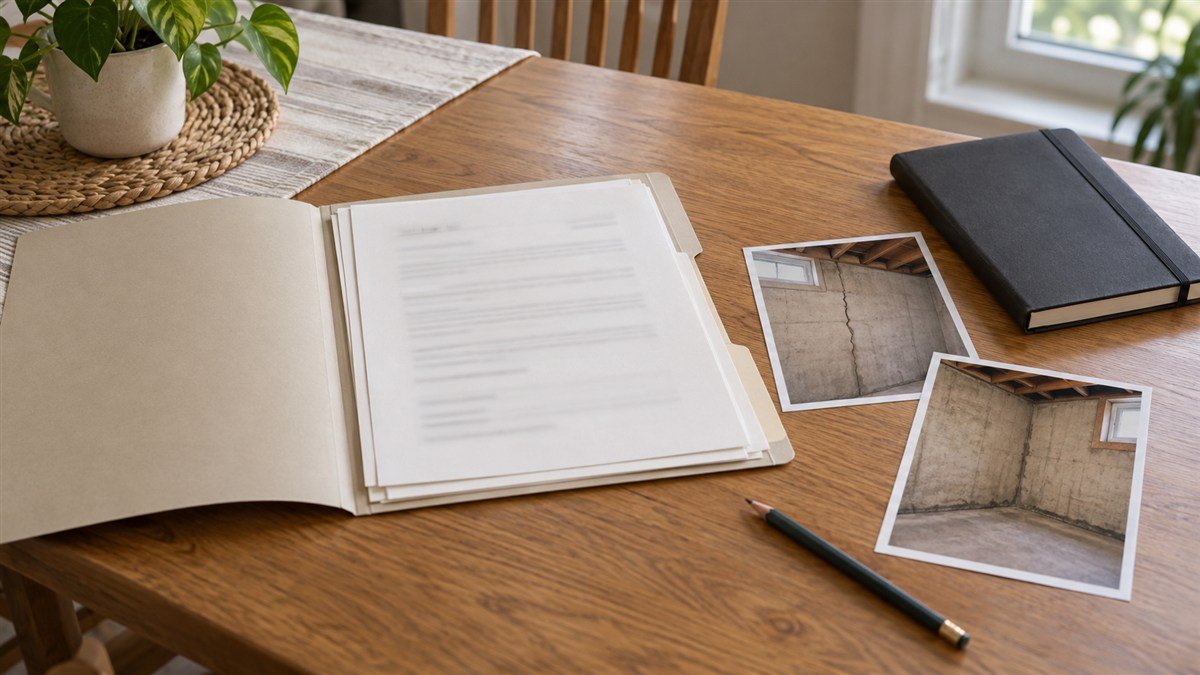
Request documents that identify the location, purpose and date of the earlier work. A useful record lets you connect a particular repair to a particular wall. A general statement that “the basement was fixed” leaves too much unclear.
| Record to request | What it can help establish | Question to resolve |
|---|---|---|
| Dated photographs with a location | Which wall or opening was photographed | Can you match it to the area seen today? |
| Earlier inspection or assessment | What was examined and reported then | What limitations or follow-up were recorded? |
| Repair proposal and completed invoice | The stated scope and work billed | Was the work for this crack or another location? |
| Written warranty and provider details | The stated repair coverage and conditions | Does the wording apply after ownership changes? |
For example, an invoice might describe one repaired crack beside the basement stairs, while your question concerns a stain below a different window. That invoice documents a different location unless other records connect the two. Ask for clarification instead of assuming that one repair covered the whole basement.
When buying a house with foundation cracks, distinguish a proposal from a completed-work record. Check whether the paperwork describes recommended work, work actually carried out or a later inspection. If the dates, wall location or descriptions do not line up, write down the mismatch and ask the relevant person to explain it.
Ask about the circumstances of earlier water problems: where moisture appeared, when it was noticed and whether it was observed again after the repair. A dry viewing is a limited observation. Our guide to a basement leaking after rain explains why weather and the location of water matter when discussing a leak.
Who should answer questions that the paperwork leaves open?
Direct each question to the person whose work or expertise it concerns. The original repair provider can clarify its records and warranty; the home inspector can explain the inspection’s findings and limits. Suspected structural damage or movement needs a structural engineer and an appropriate plan, rather than an assumption that a leak repair resolves it.
The Government of Canada’s foundation-maintenance guidance recommends professional advice before repairs and help for growing cracks, seepage or an unclear leak source. A photograph can help describe the enquiry, but it does not replace the assessment needed to answer a condition question.
When buying a house with foundation cracks, ask the inspector to name the unresolved issue as specifically as possible. “Confirm the scope of the previous repair on the rear wall” gives you a clearer next step than “ask someone about the basement.” Record who will answer and which document or visit is needed.
A contractor’s quotation describes proposed work within its stated scope. It is not a whole-home inspection or structural clearance. If further repair is proposed, the foundation crack repair cost guide explains what a clear quotation should address without assigning a price to an unseen wall.
Does a foundation crack repair warranty transfer to a buyer?
Do not assume that a warranty transfers with the house. Read the actual provider’s terms and ask for written clarification where ownership changes are not clear. “Lifetime” by itself does not tell you who is covered, which repair is covered or what conditions apply.
Aftermath’s written warranty terms for eligible crack repairs apply while the original customer owns the property. Coverage does not transfer unless Aftermath separately agrees in writing. The warranty concerns the identified treated repair, not the entire basement or a guarantee of structural condition.
For a repair by another company, use that company’s documents. Confirm the provider’s identity, the repair location, the named customer and any written transfer arrangement. Do not borrow Aftermath’s terms to interpret a different contractor’s promise.
Keep any clarification with the original warranty and repair record so the connection is easy to follow. If no written terms are available, mark coverage as unconfirmed. A verbal description of a warranty should not quietly become a confirmed item in your notes.
What should your question list include before a decision?
Build a short list that connects each unanswered question to its source and next step. This keeps old paperwork from being mistaken for a present assessment and helps you see where information is still missing. Buying a house with foundation cracks becomes a more informed discussion when everyone is referring to the same wall and records.
- Which exact wall or crack does each report, photograph or invoice describe?
- What does the current inspection say, and which areas could not be examined?
- Do the old records and today’s observations agree, or is there a specific difference to clarify?
- Has recommended follow-up been completed, and is its conclusion available in writing?
- What coverage, if any, would apply to you under the actual warranty terms?
Keep the list alongside the documents rather than replacing the documents with your own summary. For each open item, note who is being asked and whether their reply answers the question or calls for another assessment. Do not label an issue “resolved” merely because someone has provided a quotation.
Access is part of the discussion. Arrange any further visit through the appropriate property contact and ask what the professional needs to see. Do not remove finishes or disturb a wall during a viewing. Questions about purchase conditions, deadlines or contractual wording belong with your own real estate professional or lawyer.
Why Aftermath Crack Fix?
Aftermath Crack Fix provides foundation crack repair and basement and foundation waterproofing services in Toronto and its GTA service area, with free quotations. For suitable poured-concrete cracks, an interior repair may address the identified leak without exterior excavation. Suitability still depends on the assessed condition and repair objective.
Aftermath offers a lifetime warranty for eligible crack repairs under the written terms described above. A useful enquiry includes the wall location, accessible photographs and relevant prior repair details. Aftermath can discuss its repair scope and its own warranty terms; a quotation should not be presented as a whole-property inspection or an engineer’s structural opinion.

Bring the records and questions together
Buying a house with foundation cracks is a reason to connect the present findings with the property’s repair history. Match each document to the right location, preserve the limits of earlier assessments and verify warranty coverage instead of assuming it continues. The goal is a clear set of answered questions for your decision, with any remaining uncertainty visible.
Frequently asked questions
Does a foundation crack mean I should walk away from a house?
A crack alone cannot establish that decision. Its cause and condition, the inspection findings and any required follow-up need to be understood for the particular property. Use qualified advice to resolve those questions rather than treating a photograph or a generic crack-width rule as a purchase verdict.
Is a repaired foundation crack proof that the problem is fixed?
A repair record can establish what work was documented at a particular location. Check its purpose, completion details and any later observations. It does not automatically establish the condition of other cracks, concealed areas or the rest of the basement.
Can a dry, finished basement rule out previous leaks?
No. A dry viewing records conditions at that time, and finishes may limit what can be seen. Ask about available history and the inspection’s access limitations. Arrange any further assessment appropriately rather than removing finishes during the viewing.
Will a seller’s lifetime crack repair warranty cover me?
Check the actual written terms and any transfer agreement. For Aftermath’s eligible repairs, coverage applies while the original customer owns the property and does not transfer unless separately agreed in writing. Another provider may have different terms.
Is a foundation repair quotation the same as a home inspection?
No. A quotation concerns the proposed work and its scope. A home inspection examines the property within the inspector’s agreed scope, while a structural concern may need an engineer. One document should not be presented as a substitute for another.