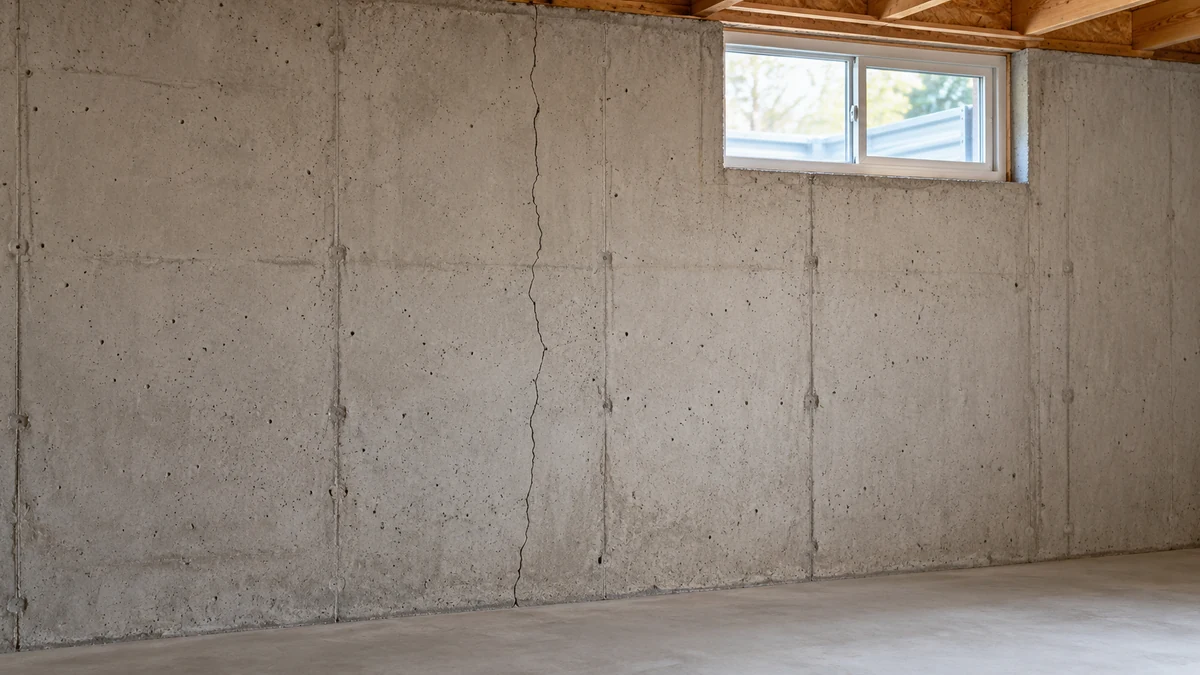
This guide helps Toronto and GTA homeowners describe a foundation crack, prepare for an assessment and understand the next step. You do not need to diagnose the cause before asking for help.
When should you worry about foundation cracks?
Give a crack prompt attention when you can see it changing or when the wall appears to be moving. A growing opening, an offset between its sides, or bowing deserves professional review rather than reassurance from an online photograph.
If a wall appears unstable or there is an immediate risk of falling material or collapse, keep away and contact emergency services.
Displacement means the sides no longer line up. Bowing means a wall curves out of its intended plane. Both are different observations from simply seeing a dark line on the surface. You can report them without deciding what caused them.
The U.S. Department of Housing and Urban Development’s Residential Rehabilitation Inspection Guide considers foundation cracking alongside distortion, wall movement and symptoms elsewhere in the building. It also describes the relationship between horizontal cracking and bowing in masonry foundation walls. These are assessment clues, not a remote diagnosis for an individual Toronto home.
Describe the change, not a diagnosis
Write down what made you concerned. “The crack appears longer than in my earlier photograph” provides a clearer starting point than “the foundation is failing.”
If you have noticed a nearby door binding or a floor feeling different, include that observation and when it began. Do not assume the symptoms share a cause; ask whether they need to be investigated together.
Keep the history clear
Avoid letting an old explanation settle a new question. A previous owner may have described a crack as “just settling,” but you may not know who assessed it or what the wall looked like then. Ask for any available report or repair record and explain what you see now.
Equally, discovering an old crack for the first time does not tell you when it formed. Say “first noticed today” when that is all you know. Keeping discovery date separate from an assumed formation date helps the person reviewing the concern understand the evidence.
What can the crack’s shape and wall material tell you?
Shape and material help describe the condition, but they do not supply a complete explanation. A vertical line in poured concrete, a stepped opening through block joints and a crack in a surface coating need to be identified accurately before they are compared. Avoid labelling every vertical crack harmless or every horizontal crack a structural failure.
- Poured concrete: a continuous wall.
- Concrete block: individual masonry units joined with mortar.
- Concealed or mixed walls: say when a finish hides the material. If the basement contains different materials or an addition, record which section you are describing.
CMHC’s archived Renovator’s Technical Guide explains that shrinkage can produce cracks and that different foundation problems can produce similar symptoms. It advises professional investigation of active cracks. That is why a shape chart should help you prepare questions rather than tell you which repair to buy.
The following comparison is an observation guide. None of these descriptions establishes a safe width, structural capacity or a repair specification.
| Observation | Useful description | Question for the assessment |
|---|---|---|
| Vertical or diagonal line | Location, visible endpoints and any recorded change | What evidence explains this crack? |
| Horizontal line | Wall material and any visible bowing or offset | Does wall movement need structural assessment? |
| Stepped opening in masonry | Whether it follows joints, crosses units or reaches an opening | What needs checking in this wall and nearby areas? |
| Crack in a coating or finish | What is visible and what remains concealed | Is the underlying foundation accessible for inspection? |
| Line through an earlier repair | Previous work, dates and the current symptom | What needs reassessment before more work is proposed? |
Why not use one width as the answer?
A measurement records one feature at one location and time. It does not tell you everything about the wall, the crack’s history or the surrounding structure.
Keep a measurement if you have it, but ask the assessor how it fits the rest of the evidence. Do not use a coin, ruler or online threshold as permission to ignore a changing condition.
How should you record a crack that may be changing?
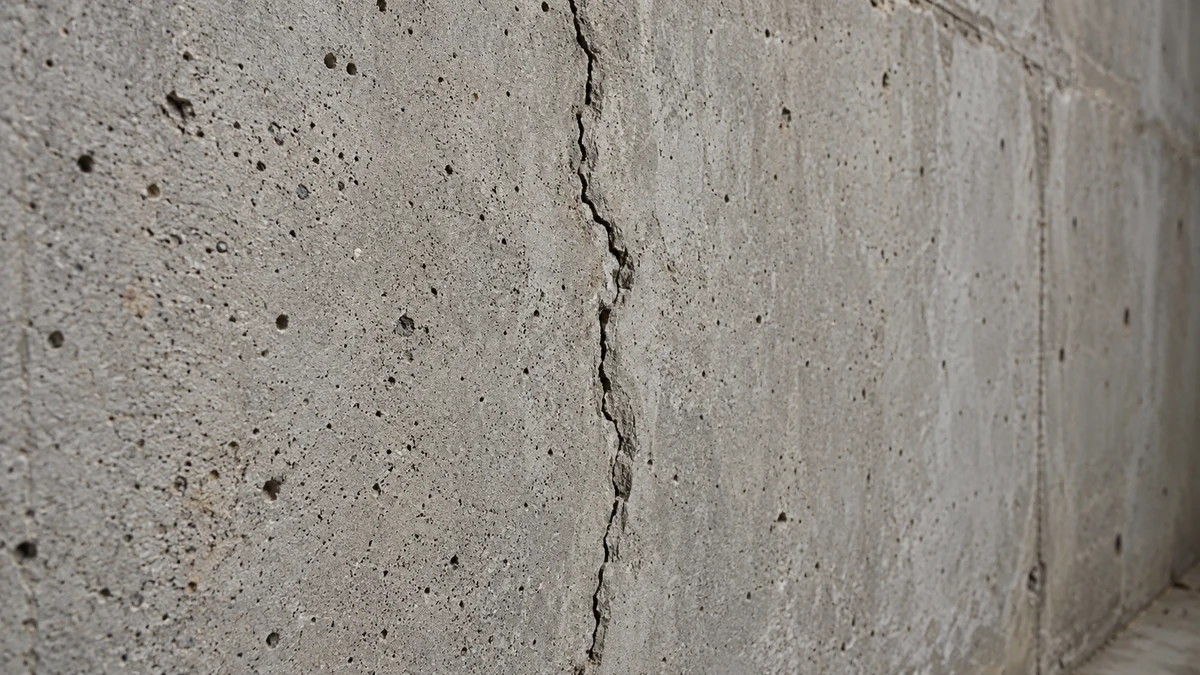
Create a clear, dated record without disturbing the wall. Keep photographs comparable and separate what you observed from what you suspect. Recording a concern should support arranging help, not delay an assessment while you wait to collect a longer history.
Start with a location label you will recognise later, such as “basement back wall, left of window.” Use the same label for photographs, notes and any questions you send. If several cracks are visible, give each a separate label so details from different areas do not get mixed together.
Take photographs that answer different questions
- Show the location: take a wide photograph of the crack on the wall.
- Show the detail: take a closer photograph of the visible line and surrounding surface. Keep original files as well as marked-up copies, and avoid filters that change the concrete’s appearance.
- Add a reference only if access is safe: place a ruler beside the area without inserting tools into the opening. Record the exact point measured and keep the camera angle as consistent as practical.
- Record uncertainty: if you cannot read a small measurement confidently, state that limitation rather than guess.
Do not chip, drill, pry or remove material to make a more impressive photograph. If storage or finishes prevent a useful view, describe the obstruction and ask what access will be needed. There is no requirement to expose a wall yourself before making an enquiry.
Keep a short observation log
A useful entry answers the following questions:
- Where is the crack, and which photographs show it?
- When did you first notice it, and when was this observation made?
- What appears different from the previous record, if anything?
- Was the visible area dry, damp or leaking at that time?
- Has work been done nearby or on this crack before?
Use neutral wording. “The lower end was hidden behind a cabinet in the earlier photo” is better than claiming the crack suddenly lengthened when the earlier image does not establish that. “No obvious change in these photographs” is more precise than calling a crack permanently stable.
When you enquire, state when you first noticed the crack and whether its earlier condition is known. Mention any previous repair nearby without assuming the two issues are related.
Discuss the next step for a foundation crack.
Call Aftermath Crack Fix at (647) 448-9123 for a free quotation for foundation crack repair in Toronto and the GTA. Describe any visible change or wall movement when you enquire so the repair discussion can account for concerns that need further assessment.
When does a structural engineer need to assess the wall?
Seek a structural engineer’s assessment when the question concerns wall movement, structural adequacy or an unexplained condition beyond a targeted crack repair. Ask for someone with appropriate experience in the type of residential foundation involved. A contractor’s quotation for a defined repair should not be treated as an engineering opinion on the building.
Professional Engineers Ontario’s structural condition assessment guideline calls for an on-site review and explains that photographs supplied by others do not replace it. The guideline also addresses review of available documents, concealed elements and a written report setting out the assessment’s scope, limitations and recommendations.
Questions when booking an assessment
Ask: “Can you assess the structural concern I am describing, and what will I receive afterwards?” Then explain:
- The visible problem and the decision you need to make.
- Whether you plan to close the wall with new finishes. Do not assume the inspection automatically covers that decision.
Ask what to gather in advance. Existing drawings, an earlier assessment or repair paperwork may help, if you have them. Do not postpone the initial enquiry because your files are incomplete; tell the engineer which records are available and which are missing.
Clarify the limits of the visit
Ask whether the review covers one wall, a specific crack or a broader set of concerns. Confirm how inaccessible areas will be described and whether another visit or additional investigation may be needed. A useful report should make it possible to distinguish an answered question from an area that could not be assessed.
If you receive advice to monitor the condition, ask who will review the results and what should trigger earlier contact. If work is recommended, ask how the repair design and contractor’s scope will be coordinated. These questions help turn the assessment into a usable next step without expecting the homeowner to interpret a technical report alone.
How should the assessment change the repair proposal?
An assessment should clarify which concern a repair will address and what still needs a decision. Match the proposed action to the findings that support it, rather than treating a repair quotation as a structural opinion. If engineering review is recommended first, confirm who will arrange it and whether the repair should wait.
Read the findings and proposal together. Look for a clear connection between the condition described, the recommended next step and the work offered. Ask about any gap between them:
- Which findings support the proposed crack repair?
- Does an observed movement concern remain unresolved?
- Is further professional review a prerequisite, and who makes that decision?
- If the assessment was limited, could an unexamined area affect the proposed work?
A repair proposal may answer only part of the concern
Consider this fictional example: a homeowner reports a leaking crack and a wall that appears to bow inward. A quotation describes sealing the crack but says nothing about the reported wall shape. That proposal identifies a water-entry repair; the homeowner still needs to establish whether the movement concern has been assessed and whether it changes the recommended work.
The example does not establish that the wall is either dangerous or stable. Its point is to keep an unanswered question visible. Ask who is qualified to address that question and obtain the necessary advice before assuming the sealing proposal resolves it.
For suitable poured-concrete cracks, Aftermath Crack Fix may carry out treatment from inside. That option needs to fit the assessed condition; it does not remove a prerequisite for structural review when one has been identified.
If the findings concern water beyond one identified crack, Aftermath’s basement and foundation waterproofing service can be discussed in relation to that wider water problem. Ask which finding the proposed scope addresses and which questions remain outside it.
Once the appropriate next step is clear, confirm the treated location, access arrangements and applicable warranty in the written scope. Keep the assessment’s unresolved concerns separate from work already agreed, so nobody mistakes a repair appointment for completion of the investigation.
What should happen after the assessment?
Leave with a clear next action and an identified person responsible for reviewing the result. The outcome may be a defined repair, further investigation or a monitoring plan chosen for the circumstances. Ask for clarification if the recommendation leaves you unsure who acts next or when to seek help again.
Before the discussion ends, make sure you can answer:
- What wall, crack or structural concern was assessed?
- What was concealed, outside the scope or left unresolved?
- What action did the professional recommend, and are there prerequisites?
- Who arranges the next step and who reviews its result?
- When and how should you make contact again?
Make monitoring a defined plan
If monitoring is recommended, settle these points with the professional responsible:
- Its purpose and duration.
- Where to make observations and how often to record them.
- Which changes require earlier contact.
Request instructions you can follow without having to decide for yourself whether a measurement proves structural safety.
A monitoring recommendation needs a review plan. Taking photographs indefinitely without knowing who will interpret them leaves the original question open.
Ask what decision the monitoring is meant to inform and how you will learn whether more investigation, repair or continued observation is appropriate. These are questions to settle with the responsible professional, not universal monitoring intervals for every house.
Before concealing the wall with finishes, clarify any outstanding access or review requirement. If a new concern arises, contact the appropriate professional rather than waiting solely because a later review date was discussed.
Why Aftermath Crack Fix?
Aftermath Crack Fix provides foundation crack repair for suitable poured-concrete walls in Toronto and the GTA, with free quotations and interior treatment where conditions allow. The repair discussion should establish what can be addressed within that scope and what needs further assessment.
Eligible crack repairs carry a lifetime warranty for as long as the original customer owns the property, subject to the written terms. Coverage applies to the eligible repair and is non-transferable unless separately agreed in writing. Review the applicable terms with your quotation.
Request a free foundation crack repair quotation.
Call (647) 448-9123 or review Aftermath’s foundation crack repair service and warranty terms. Explain what you have noticed and any assessment already completed so the conversation begins with the condition of your wall.
Conclusion
When should you worry about foundation cracks? Take visible change and possible wall movement seriously enough to arrange the right assessment, while avoiding a diagnosis based on one measurement or photograph. A clear record, an appropriately qualified reviewer and a repair scope that answers the actual concern give you a more useful next step than a universal crack-size rule.
Frequently asked questions
Are vertical foundation cracks always harmless?
No. Direction alone does not establish the condition. Record any change and ask how the crack relates to the wall around it. HUD’s inspection guidance considers a combination of symptoms, so a vertical orientation should not end the assessment conversation.
Do horizontal cracks mean the foundation is failing?
They do not establish that conclusion on their own. Horizontal cracking, particularly with bowing or displacement, warrants prompt professional assessment. HUD discusses these features together in masonry walls; the cause and appropriate response still depend on the property.
Is there one crack width that means I should worry?
This guide does not use a universal safety threshold. Keep any reliable measurement as part of the record and ask the assessor to interpret it alongside the wall condition and history. A size comparison cannot establish structural adequacy.
How can I tell whether a foundation crack is getting worse?
Dated, comparable photographs can help you describe a possible change. CMHC’s renovation guidance recognises monitoring as a way to investigate whether movement continues, while advising professional investigation of active cracks. Do not wait for a monitoring period to end if new concerns arise.
Can a structural engineer assess a crack from photos alone?
Photographs can support the initial conversation, but PEO’s structural condition assessment guideline requires an on-site review. Ask the engineer what information to send beforehand and what access the visit requires. A remote comment should not be confused with that assessment.
Should I fill a crack before someone inspects it?
Ask the person assessing the condition before altering or covering it. Preserve photographs and available records, and explain any repair already attempted. If the concern involves structural movement, arrange the appropriate assessment before treating a patch as the answer.