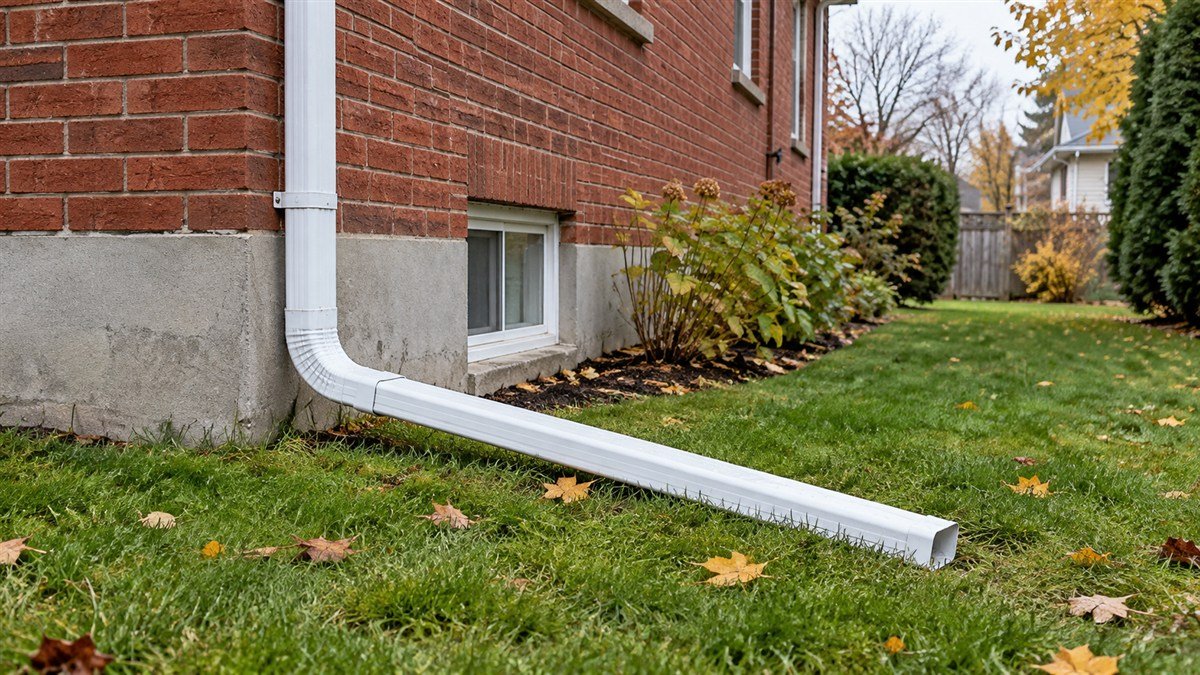
AI-generated editorial illustration; not an Aftermath project or a measured drainage design.
Do downspout extensions work to reduce basement leaks? They can help when roof water is being released too close to the house and the extension carries it to a suitable drainage area. A leaking basement still needs its own explanation: moving an outlet and repairing a water-entry path are different tasks.
For a Toronto homeowner, the useful question is where the water goes next. A longer pipe is only part of that picture. This guide explains what to look at from ground level, what an extension cannot establish and what information helps when you ask for an assessment.
How do downspout extensions work?
A downspout extension continues the route from the vertical roof-drainage pipe to a discharge point farther from the house. It can reduce the amount of roof runoff delivered immediately beside the foundation. Its value depends on a connected, clear route and a place where the discharged water can drain.
Eavestroughs collect roof runoff, and downspouts carry it toward the ground. The Government of Canada explains how properly installed and maintained eavestroughs and downspouts help direct water away from exterior walls and foundations. The extension is the final visible part of that route, rather than a treatment applied to the basement wall.
Start by distinguishing what you have seen from what you suspect. “The outlet ends beside this corner” is an observation. “This outlet caused the basement leak” is a conclusion that may need further investigation. A clear photograph of the layout helps someone assess the first without assuming the second.
If water appears indoors after a storm, keep the drainage observation alongside the broader history in our guide to basement leaking after rain. That history helps determine whether the outside change and the inside symptom are actually connected.
Where should the water go after the extension?
The outlet should discharge to a suitable area away from the foundation, with a route that does not send water back toward the building or create a problem elsewhere. The City of Toronto recommends that disconnected downspouts drain properly, ideally two metres from foundation walls. That is guidance for the drainage arrangement, not proof that one standard pipe length fits every yard.
Toronto’s basement-flooding prevention guidance also calls for ground to slope away from the foundation without adversely affecting neighbouring properties. Look at the relationship between the outlet, the ground and nearby openings.
Do downspout extensions work if the outlet ends in a low spot? Moving the outlet does not establish that water can drain from its new location. Include that low area when discussing the route.
Use the following observations to make your enquiry more precise. They are prompts for discussing the site, not a pass-or-fail inspection or instructions to redesign its drainage.
On a narrow screen, scroll the table sideways.
| Part of the route | Useful observation | Question to take forward |
|---|---|---|
| Connection | The extension is attached, loose or separated. | Is water reaching the intended outlet? |
| Outlet | Photograph where the pipe ends. | Is this a suitable discharge location? |
| Ground beyond it | Note visible pooling or a return path. | What happens after water leaves the pipe? |
| Nearby features | Include paths, windows and property edges. | Could the route affect another area? |
| Inside the basement | Mark the wet area on a simple room sketch. | How does it relate to the outside layout? |
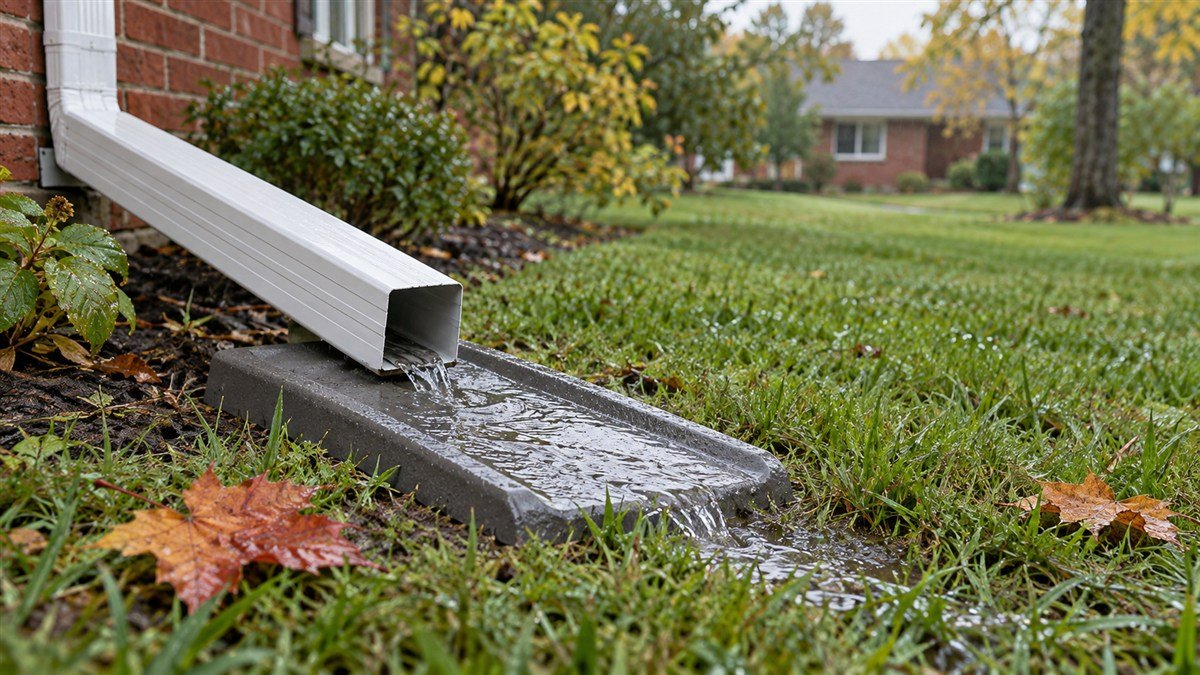
What can keep an extension from helping?
Do downspout extensions work when the eavestrough overflows? An extension cannot redirect water that spills before it reaches the pipe. Locate the problem along the whole route rather than judging the extension from a dry-weather photograph alone.
The federal maintenance guidance recommends checking eavestroughs and downspouts in spring and fall, and more frequently after severe weather or when ice builds up. Arrange appropriate help for work above ground level; the observations in this article do not require climbing onto a roof or working from a ladder.
- Describe where the water escaped. Note whether you saw an overflowing eavestrough, a leaking joint or water at the intended outlet. These describe different parts of the route.
- Include the surrounding ground. A close-up of the pipe alone can leave out the low spot or nearby opening that explains your concern.
- Keep track of changes. Record when an extension was moved, detached or replaced, so the person assessing a repeat leak has the correct sequence.
Winter needs a usable drainage route too. Toronto’s downspout-disconnection guidance cautions against ice and trip hazards and directs water away from buildings, neighbours, driveways and sidewalks. It also says to add an extension after removing a rain barrel for winter. If a narrow lot leaves no obvious safe route, seek advice about the layout rather than improvising a discharge point.
Does less runoff mean the foundation crack is repaired?
Do downspout extensions work as a substitute for repairing a leaking crack? No: moving roof runoff does not fill or repair the crack in the wall. If water is entering through a suitable poured-concrete crack, the proposed repair needs its own assessment and defined scope.
A quieter leak after an outside change is useful history, but it does not show what happened inside the concrete. Tell the assessor both parts of the story: what changed outside and what you observed indoors afterwards. Avoid covering the evidence with a new surface treatment simply to make the area look finished.
Aftermath assesses suitable cracks for interior polyurethane or epoxy injection. That scope is different from changing a downspout, investigating underground drainage or treating every possible source of basement moisture. When water appears in several places, a wider waterproofing assessment may be more appropriate than assuming the nearest visible crack explains it all.
The location also matters. A concern around a window belongs in the context of window-well flooding; moisture spreading across the floor may need the separate checks discussed in water seeping through a basement floor. Suspected structural movement, bowing or displacement calls for a structural engineer and an appropriate plan, rather than a promise that drainage changes or injection will stabilise the wall.
What should you show a professional?
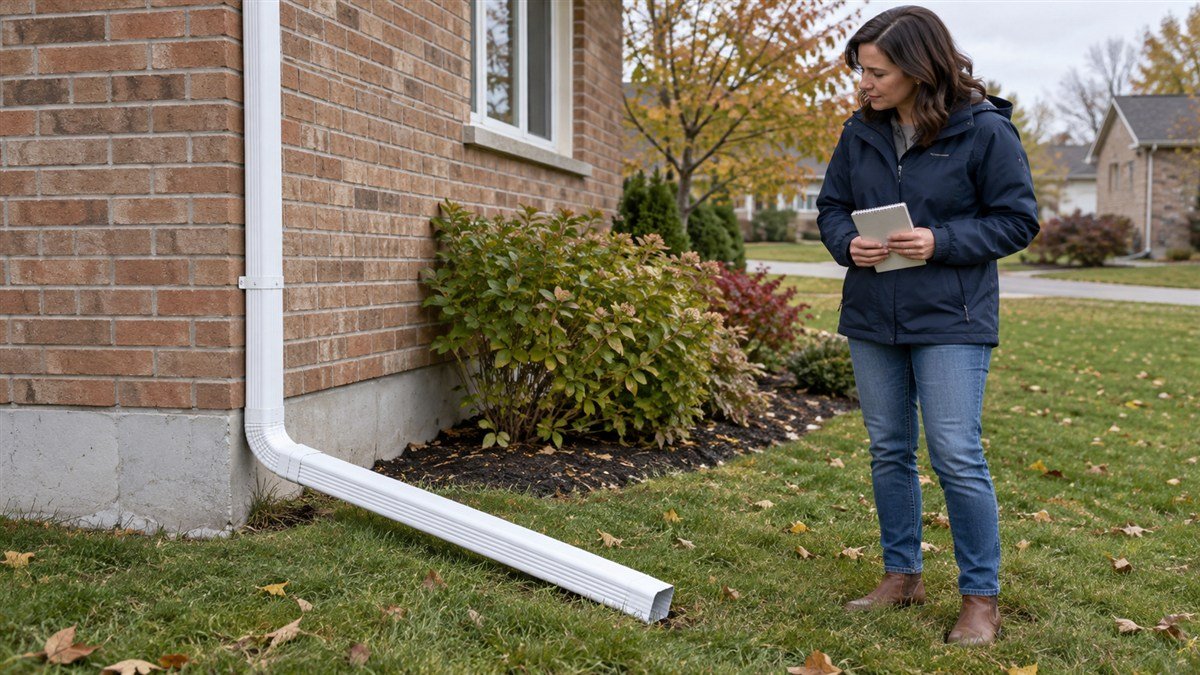
Bring a simple record that links the outside layout to the inside symptom without claiming a diagnosis. Wide photographs, a short timeline and the location of previous repairs give the assessor a useful starting point. An on-site visit may still be needed.
- One outside overview: include the house corner, downspout, extension and area beyond its outlet. Photograph only from a safe, accessible position.
- One inside overview: show the affected wall or floor in relation to a window or room corner, followed by a closer image if useful.
- A short timeline: note when water was first seen, whether rain or thaw was occurring, and when any drainage or crack-repair work happened.
- Access details: explain whether drywall, insulation, storage or landscaping conceals the area. Agree on any opening or reinstatement work before it begins.
- The question you need answered: for example, whether the leak is through a particular crack, whether more than one entry point needs assessment, or who should investigate the drainage route.
Ask the proposed contractor to distinguish the observations, the remaining uncertainties and the work included in the quotation. A quotation for a treated crack should identify that location; advice about a downspout should not silently become an assumed promise to install a complete drainage system.
Why Aftermath Crack Fix?
Aftermath Crack Fix provides foundation crack repair and basement/foundation waterproofing for Toronto and approved GTA service areas. We assess the wall, water pattern and access before recommending work, and offer free quotations. Interior repairs can avoid exterior excavation where the crack and site conditions are suitable.
Eligible crack repairs carry a lifetime warranty for as long as the original customer owns the property. Coverage is non-transferable unless separately agreed in writing and is not a whole-basement or structural guarantee. Read the eligible crack-repair warranty terms for the scope and claim process.
Choose the next step from the water route
Do downspout extensions work? They can be a useful part of managing roof runoff when the discharge route suits the property. Follow that route beyond the outlet, keep the maintenance history and assess any continuing basement leak on its own evidence. That gives both the outside drainage concern and the foundation repair the attention each needs.
Frequently asked questions
How far should a downspout extend from the house?
Toronto’s guidance says disconnected downspouts should drain properly, ideally two metres from foundation walls. The outlet and surrounding ground must work together; a distance by itself does not establish a suitable route.
Are downspout extensions necessary at every outlet?
Each outlet needs a suitable drainage arrangement. Whether an extension is needed depends on the existing discharge point and property layout. A product photograph or another home’s arrangement cannot settle that question for your house.
Should you remove downspout extensions in winter?
Do not leave roof runoff without a suitable route simply because the season changes. Check for ice and other obstructions, and follow the guidance for your installation. If removing a rain barrel, Toronto advises adding an extension to maintain drainage away from the home.
Is a splash pad the same as a downspout extension?
They serve different roles. An extension carries water along the pipe to its outlet; a splash pad helps direct the discharge and limit erosion where it lands. Neither establishes that the rest of the drainage route is suitable.
Will a downspout extension fix a leaking foundation crack?
It does not repair the crack itself. Explain any change in leakage after drainage work, then have the water-entry path assessed. Suitable crack repair and broader waterproofing address different parts of the problem.